

-
Sacred Glow Elixir 30ml – Vitamin C Serum for Indian Skin
Regular price Rs. 799.00Regular priceRs. 1,099.00Sale price Rs. 799.00Sale -
Sacred Glow Elixir 15ml – Vitamin C Brightening Serum
Regular price Rs. 399.00Regular priceRs. 599.00Sale price Rs. 399.00Sale

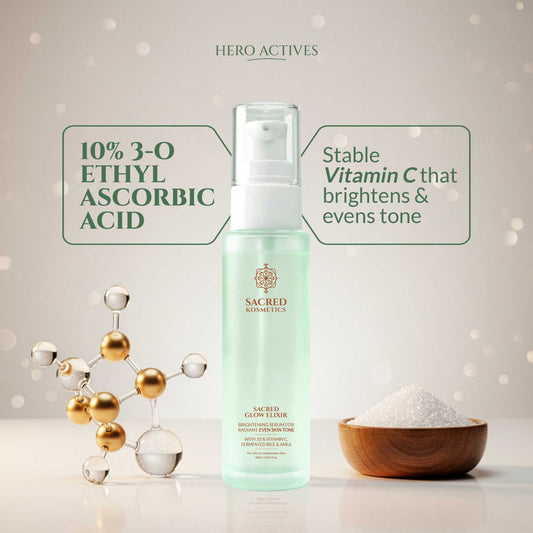

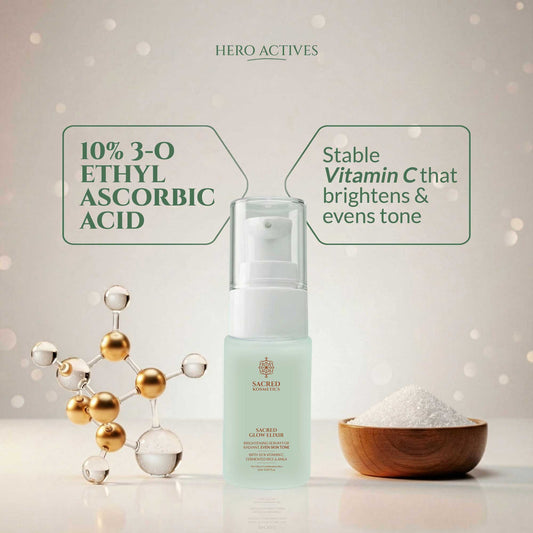
If you are looking to buy the best vitamin C serum for Indian skin, the formula matters more than the brand name on the label. Most vitamin C serums sold in India are formulated for temperate climates where heat stays below 25 degrees Celsius and humidity rarely crosses 60 percent. Indian summers routinely hit 38 to 42 degrees with humidity above 80 percent in coastal cities. In those conditions, the wrong vitamin C formula turns orange in your bathroom cabinet before you finish the first third of the bottle. The Sacred Glow Elixir is formulated specifically for this reality, using stable vitamin C derivatives that maintain potency through Indian heat, monsoon humidity, and year-round UV exposure.
The Real Reason Vitamin C Serums Fail in Indian Climate
L-Ascorbic Acid is the most researched form of vitamin C, but it is also the most unstable. It oxidizes rapidly when exposed to heat, light, and air. In Indian summer temperatures that regularly exceed 38 degrees Celsius, a vitamin C serum in a clear bottle can degrade within three to four weeks of opening. You are not imagining it when your serum turns yellow or orange. That color change means the active ingredient has already broken down and is delivering zero brightening benefit.
This is not a vitamin C problem. It is a formulation problem. Stable derivatives like Ethyl Ascorbic Acid and Ascorbyl Glucoside are engineered to resist oxidation in heat and humidity. They convert to active vitamin C inside the skin rather than degrading in the bottle. For anyone living in Mumbai, Chennai, Bangalore, Hyderabad, or Delhi, stable derivatives are not a premium option. They are the only option that actually works.
If your current vitamin C serum is not delivering results, the most likely explanation is that it oxidized before it could work. This is the most common reason vitamin C serums fail on Indian skin, and it is entirely preventable by choosing the right formulation. Read more about how to prevent vitamin C oxidation in Indian climate and what signs to look for before your serum stops working.
What Vitamin C Actually Does for Melanin-Rich Indian Skin
Vitamin C works through two distinct mechanisms that make it particularly valuable for Indian skin. First, it inhibits tyrosinase, the enzyme responsible for melanin production. By slowing tyrosinase activity, vitamin C reduces the rate at which new pigmentation forms. Second, it provides antioxidant protection against the UV radiation and pollution that continuously stimulate melanin production in Indian urban environments.
For melanin-rich skin, this dual action matters more than it does for lighter skin types. Indian skin produces melanin at a higher rate in response to inflammation, UV exposure, and even minor friction. Every breakout, every threading session, every day of unprotected sun exposure creates a new pigmentation trigger. Vitamin C addresses both the existing pigmentation and the ongoing triggers that create new dark spots.
Post-inflammatory hyperpigmentation is the primary concern for most Indian skin types. PIH occurs after any inflammatory event, including acne, eczema, waxing, and even aggressive cleansing. The dark marks that result can persist for six to twelve months without targeted treatment. Vitamin C, used consistently, accelerates the fading process by reducing melanin synthesis at the site of inflammation. For a deeper understanding of how pigmentation forms and how to treat it, see our guide on vitamin C for dark spots in India.
How to Choose the Right Vitamin C Percentage for Indian Skin
The assumption that higher concentration equals better results is one of the most persistent myths in skincare. For Indian skin, it is also one of the most damaging. Higher concentrations of L-Ascorbic Acid increase irritation risk, and irritation in melanin-rich skin triggers post-inflammatory hyperpigmentation. You end up with more dark spots, not fewer.
10 percent is the sweet spot for most Indian skin types. It delivers meaningful tyrosinase inhibition without the irritation risk of 15 or 20 percent formulas. For sensitive or reactive skin, starting at 5 percent and building tolerance over four to six weeks is the more sustainable approach. The goal is consistent daily use without barrier disruption, not maximum concentration.
Stable derivatives at 10 percent outperform unstable L-Ascorbic Acid at 20 percent in real-world Indian conditions. A serum you can use every day without irritation will always deliver better results than a high-concentration formula that sits unused because it stings or oxidizes. For a complete breakdown of which percentage works for your skin type and concern, read our vitamin C serum percentage guide for Indian skin.
Vitamin C and Sunscreen: The Non-Negotiable Pairing for Indian Skin
No vitamin C serum delivers results without consistent sun protection. UV exposure is the primary ongoing trigger for melanin production in Indian skin. Without daily SPF 30 or higher, vitamin C corrects existing pigmentation while new pigmentation forms continuously from daily sun exposure. The net result is no visible improvement despite consistent serum use.
Vitamin C and sunscreen work synergistically. Vitamin C neutralizes free radicals that sunscreen does not block, providing antioxidant protection that extends beyond the UV-blocking function of SPF. Sunscreen reduces the UV-generated melanin stimulation that vitamin C must counteract. Together they provide significantly better protection against new pigmentation than either alone.
Apply the Sacred Glow Elixir in the morning after cleansing, allow it to absorb for two minutes, then layer your moisturizer and SPF. This sequence ensures vitamin C is present as an antioxidant shield throughout the day when UV and pollution exposure is highest. For guidance on layering vitamin C with other actives, see our complete guide on using vitamin C serum for sensitive Indian skin.
Who Should Use Vitamin C Serums and When to Start
Vitamin C is appropriate for most Indian skin types from the mid-twenties onward, though starting earlier for prevention is entirely reasonable. If you are dealing with PIH from acne, uneven tone from sun exposure, or general dullness from pollution and heat, vitamin C is a direct intervention for all three concerns.
Oily and acne-prone skin types benefit from lightweight, water-based vitamin C formulations that absorb without congesting pores. Dry skin types need vitamin C paired with adequate hydration to prevent the serum from sitting on a compromised barrier. Sensitive skin types should start with lower concentrations and stable derivatives that do not require low pH to activate, reducing irritation risk significantly.
For Indian men dealing with post-shave pigmentation and sun damage, vitamin C addresses both concerns without requiring a complex routine. Two products, consistent use, and SPF is enough to see meaningful improvement over eight to twelve weeks. If you are unsure which vitamin C formulation suits your specific skin type and concern, our guide on vitamin C serum for oily skin in India covers the full selection framework.
Realistic Timelines: What to Expect When You Buy Vitamin C Serum in India
Visible brightening from vitamin C typically appears after six to eight weeks of consistent daily use. This is not a product failure. Melanin regulation is a biological process that operates on the skin's natural cell turnover cycle, which takes approximately 28 days in younger skin and longer as skin ages.
Dark spots from recent breakouts respond faster than long-standing sun damage. Fresh PIH that is still in the inflammatory phase can show meaningful improvement in four to six weeks. Dark spots from years of cumulative sun exposure require three to four months of consistent treatment and sun protection to fade significantly.
Consistency matters more than concentration. Daily use of the Sacred Glow Elixir at 10 percent Ethyl Ascorbic Acid will outperform sporadic use of a 20 percent L-Ascorbic Acid formula every time. The serum that you actually use every morning is the one that delivers results. Affordable vitamin C serums for Indian skin under ₹1000 that maintain stability through Indian conditions are more effective than expensive imported formulas that oxidize within weeks.
Layering Vitamin C With Other Actives Without Irritation
Vitamin C pairs well with niacinamide, hyaluronic acid, and peptides. The myth that vitamin C and niacinamide cannot be used together has been thoroughly debunked. The reaction that causes concern only occurs at high temperatures during manufacturing, not on skin at room temperature. Using both in the same routine addresses pigmentation through complementary mechanisms and delivers better results than either alone.
Avoid layering vitamin C with strong AHAs or BHAs in the same morning routine unless your barrier is exceptionally resilient. For most Indian skin types, morning vitamin C with SPF and evening barrier repair with niacinamide or bakuchiol is the most effective and sustainable approach. This prevents the barrier disruption that triggers new PIH while actively correcting existing pigmentation.
For those managing early aging alongside pigmentation, the Sacred Glow Elixir pairs directly with the Sacred Youth Elixir for a complete morning and evening ritual that addresses both brightening and cellular renewal without barrier compromise.
Where to Buy Vitamin C Serum for Indian Skin Under ₹1000
When shopping for vitamin C serums in India, prioritize formulations that use stable derivatives, are packaged in opaque or airless containers to prevent light and air degradation, and have lightweight textures appropriate for Indian humidity. Avoid serums with pure L-Ascorbic Acid in clear glass bottles, which will degrade in Indian conditions and deliver no brightening benefit regardless of the concentration on the label.
The Sacred Glow Elixir is available in 15ml and 30ml sizes, both priced under ₹1000, with free shipping across India and cash on delivery available. It uses 10 percent Ethyl Ascorbic Acid, the most stable and humidity-resistant vitamin C derivative for Indian conditions, formulated without fragrance, alcohol, or irritating additives that compromise barrier health.
For those building a complete pigmentation-fighting ritual, the Sacred Glow Elixir works alongside serums for hyperpigmentation and dark spots to address both the brightening and the barrier support that effective pigmentation treatment requires. Shop the Sacred Glow Elixir and start your ritual today.


The future of skincare begins with Sacred Kosmetics
Where Ayurvedic wisdom meets J beauty precision and K beauty innovation. Every ingredient is selected for safety and performance on melanin rich Indian skin.
Purity in every drop
Full ingredient transparency and clear concentration listing for informed skincare decisions.
Clinically thoughtful
Ayurveda, J beauty and K beauty combined to create science led serums for Indian skin.
Accessible luxury
Premium actives at honest prices so more people can enjoy visible results.
Sourced with intention
Actives selected from the best regions for purity, potency and long term benefits.